By Janet Bond Brill
Author of “Little Edna’s War”
Edna Brill was a beloved fixture of Allentown’s Jewish community for almost 60 years. Moving here in 1966 with her husband, Harry, and their two young sons, Sam and Eli, and becoming members of Congregation Sons of Israel and later Congregation Keneseth Israel, the Brills became an integral part of Jewish life in the Lehigh Valley.
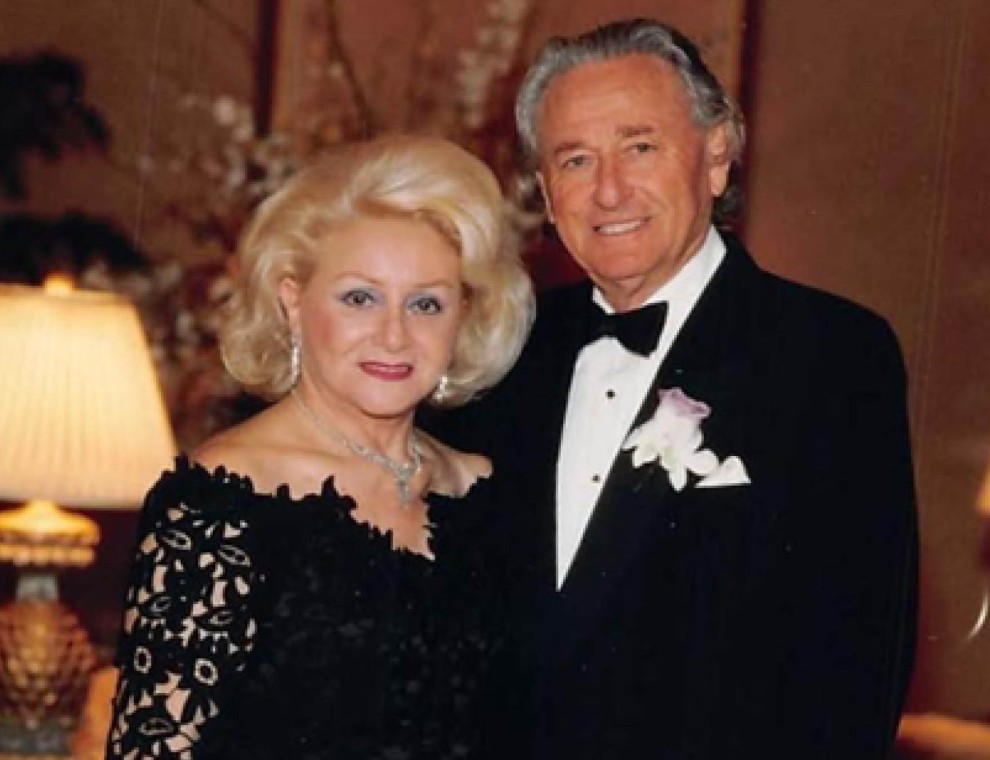
Edna was that grandmother—warm, glamorous, larger than life. Every weekend, she and Harry attended galas and community affairs, Edna stunning in magnificent clothes and jewelry. Her chicken soup was legendary. Her hugs unforgettable. When she died in 2019 and was laid to rest at the KI cemetery, the community mourned a woman they thought they knew.
But there was a story Edna kept close for decades, a story most of us never knew, a story that finally has been told. On January 27, International Holocaust Remembrance Day, my book “Little Edna’s War: A Holocaust Memoir” was published. I’m Edna’s daughter-in-law. She asked me, “Who will tell my story when I die?” I became the answer to her question.
The glamorous grandmother who lit up every room had another name once: Stefcia, a diminutive of the Polish Stefania. She kept the full form as her middle name for the rest of her life: Edna Stefania Brill. Because Stefcia wasn’t just a disguise. Stefcia saved her life.
Born at Warsaw’s Mila 18
Edna was born October 2, 1934, in Warsaw, Poland—at 18 Mila Street. That address would become famous as the command headquarters of the Warsaw Ghetto Uprising. Her childhood home became the symbol of Jewish resistance.
But before the uprising, before the ghetto, there was September 1, 1939. Four-year-old Edna was at a birthday party when the Luftwaffe bombed Warsaw. It took her and her sister Miriam three days to find their way home through the rubble. Edna told me she remembered her eyes burning from the soot 50 years later. That birthday party, she said, was “the last moment of my childhood.”
7-year-old smuggler
By 1941, Edna and her family were trapped in the Warsaw Ghetto—450,000 Jews imprisoned in 1.3 square miles. The Nazis calculated precisely: 184 calories per Jew per day. Systematic starvation. Five thousand people died a month.
So at age 7, Edna became a smuggler. Every morning before dawn, she and her siblings crawled through tiny holes in the ghetto walls to the Aryan side, risking death to bring back food. If caught, children were shot on sight. She told me, “I could fit potatoes in my coat pockets, carrots tucked into my waistband, but I had to hide it just right.”
These young smugglers—hundreds of them—were the ghetto’s lifeline. They were the first resistance fighters. Not the dramatic armed uprising we remember, but the daily acts of courage that kept families alive.
Stefcia, the hidden identity
In 1942, Edna’s mother made a desperate decision. She sent her two daughters to live on the Aryan side with false Catholic identities. Edna’s brother Yakov obtained the names of two dead Catholic girls: Stefcia and Marysia Skolkowska.
For nine years, from age 7 to 16, Edna lived as Catholic. She attended Mass, learned Catholic prayers. By the time the war ended, Hail Marys came more naturally than Hebrew prayers. Even after liberation, she couldn’t reclaim her Jewish identity. The psychological wounds ran too deep.
It took her brother singing their mother’s Yiddish lullaby to unlock her buried memory. But even then, the integration was complex. She kept all her Catholic artifacts—rosaries, prayer books, convent school memorabilia—forever. Those years were real. That childhood was real.
Yet in her later years, Edna became fiercely Jewish. She chose to be defined as Jewish—over and over again. That choice was its own act of resistance.
The youngest soldier
At age nine, during the August 1944 Warsaw Uprising, Edna fought as a courier for the Polish Home Army. They gave her a pistol—small enough for her hands. She carried military intelligence through burning streets. When a German grenade exploded near her, shrapnel tore into her small body. She kept fighting.
On her 10th birthday—October 2, 1944—Warsaw surrendered. Before the formal surrender, they held a ceremony in the ruins. Among those decorated: a little girl who had just turned 10. Edna received the Cross of Valor, Poland’s highest award for combat bravery. She was the youngest decorated soldier in the Polish Home Army.
The Pope’s blessing
In November 1946, Pope Pius XII personally honored 15 Polish Catholic resistance fighters, including 12-year-old Stefcia. He blessed her, praised her courage, celebrated her faith defending “Christian Poland against the godless Nazis.” He had no idea she was Jewish.
Even one year after liberation, Edna was still hiding. She wouldn’t reclaim her Jewish identity until 1950—five years after the war ended.
Exodus, kibbutz, and America
Her brother Yakov co-founded Kibbutz Lohamei Hagetaot—the Ghetto Fighters’ Kibbutz—with other Warsaw Ghetto Uprising survivors. Edna lived there and met Harry Brill, who had survived in the forests and was a passenger on the legendary steamship Exodus 1947. They married, had two sons, and, in 1966, made Allentown their home.
The triumph
Here’s what the Nazis never anticipated: Edna didn’t just survive; she thrived. She lived with joy, glamour, social connection, and fierce love. Every weekend at a gala, every embrace of her grandchildren, every magnificent outfit—that was her saying to the Nazis, “You failed. I won. Look at this beautiful life I built.”
That’s the ultimate victory. That’s resistance that lasted a lifetime.
Who will tell your story?
Edna spoke publicly about her experiences, including at Lehigh University. She recorded over five hours of testimony with the USC Shoah Foundation. But she knew video testimony reaches limited audiences. She asked me, “Who will tell my story when I die?”
Within five years, there will be no living Holocaust survivor voices left. One hundred thirty-one WWII veterans die per day. Every survivor’s family faces that question.
“Little Edna’s War” is my answer to Edna’s question. This is my promise kept.
Janet Bond Brill is an internationally recognized author of four books with over 200,000 copies sold. “Little Edna’s War: A Holocaust Memoir” is available at LittleEdnasWar.com.