By Carl Zebrowski
Editor
Who knew that Allentown’s glamorous grandmom Edna Brill z”l risked her life as a young kid to smuggle food past Nazi guards to Jews starving in the Warsaw Ghetto and carry sensitive messages to and from the Polish resistance? Until recently, it turns out, almost no one.
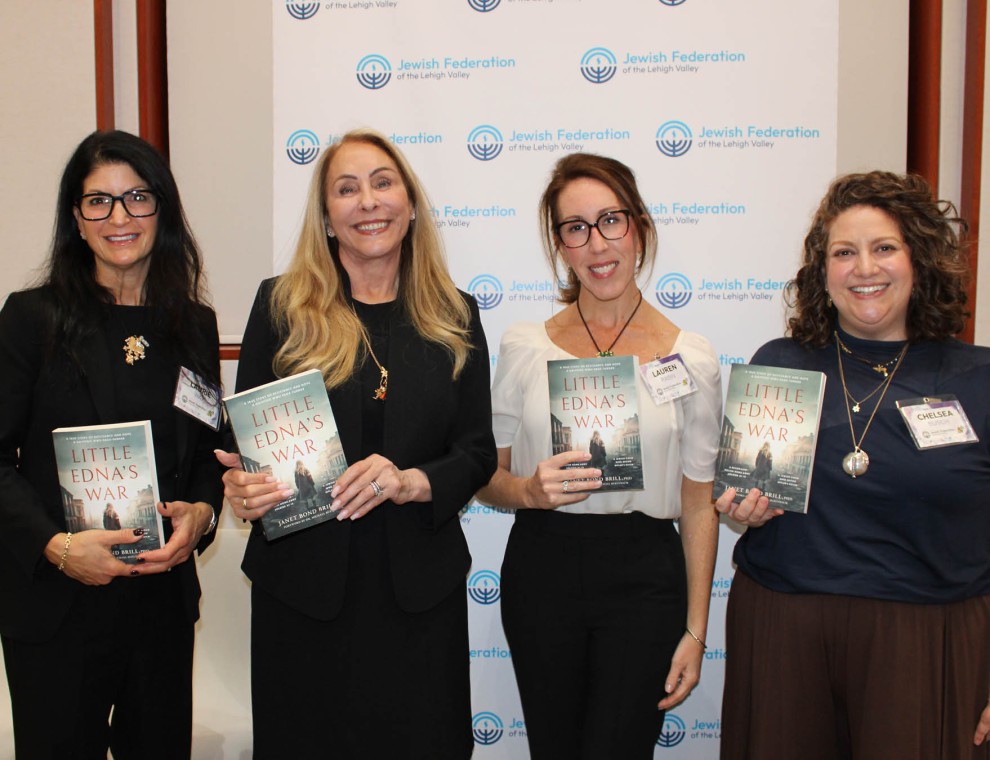
That changed when Dr. Janet Bond Brill released the book “Little Edna’s War” about her mother-in-law’s life in late 2025. On October 29, Brill visited Allentown to tell Edna’s story of courage, love, and remembrance in person to an audience of Jewish Federation of the Lehigh Valley Lion of Judah and Pomegranate Society women and other community members at Chabad of the Lehigh Valley.
Inspired by Brill’s visit and Edna’s story of Holocaust bravery and resilience followed by commitment to the Lehigh Valley Jewish community that she adopted later in life, three women talked to the crowd about the importance of supporting the Jewish community through good times and bad, so it’s able to meet challenges and grow together as one.
Laurie Wax, a Lion of Judah and past president of Women’s Philanthropy who co-chaired the event along with Chelsea Busch, Valeska Zighelboim, and Beth Kushnick, told the audience that some people are born into the imperative to support the community while others learn it along the way. “For some, like me, it came later in life, marrying into a family where giving back was not a choice but an obligation.”
How much should you give? She said her father-in-law, Stan Wax, advised her and husband Robby Wax, “Anything you both decide to give is a beautiful gift.” A little more specific? “Give until it hurts just a little bit.”
Roberta Penn, a Pomegranate wearing her mother’s pomegranate pin, shared her family’s long-standing connection to the Federation, along with their legacy of leadership, generosity, and involvement. She reflected on the importance of carrying our Jewish values and commitment to philanthropy forward and her words beautifully reinforced the spirit of “Federation for the Generations” and the impact we can make today to ensure a strong, vibrant Jewish community for tomorrow.
Chelsea Busch, Maimonides Society member and Pomegranate, pointed to the importance of strengthening the Jewish community by making sure you raise your kids immersed in Jewish life, traditions, and values. “In today’s world, raising Jewish children feels as important as ever,” she said. “Judaism is a legacy. It’s passed on by parents and grandparents as it was by their parents and grandparents.”
Brill told the audience that Edna was born in 1930s Poland and faced challenges that most of us today can only read about, listen to witnesses describe, and imagine. She went far beyond what anyone could expect of someone at her very young age to supporting and aiding her fellow Jews in need.
The Nazis invaded Poland in 1939. A year later they created the Warsaw Ghetto, Brill said, “built by Jews, paid for by Jews.” Ten-foot brick walls topped with barbed wire surrounded 1.3 square miles. “This was Edna’s entire world now,” Brill explained.
Food was scarce for the 460,000 Jews forcibly packed inside those walls. It was starvation by design, Brill said, “murder without a firearm.” It fell to children, including 7-year-old Edna, to help those in danger of starving to death. Kids would escape through small holes in the wall and return with whatever bits of food they scraped up, hiding it on themselves and wearing nonchalant faces as they passed Nazi soldiers.
“If caught,” Brill said, “they could be shot on sight.” If that isn’t horrific enough, once the Nazis realized what the kids were doing, they upped the ante. They had soldiers roam the streets with the specific goal of hunting down and shooting the little smugglers. One photo that Brill showed to the audience depicted one especially notorious child hunter holding a rifle mere feet away from Edna.
By the time the Nazi reign ended five years into the war, in the spring of 1944, Edna was still alive. That put her in a tiny minority: of the 1 million Jewish children in Poland before the war, only 5,000 survived. That could be the result of nothing less than a deliberate Nazi effort to murder children, who otherwise would grow up to raise the next generation of Jews. “Their aim was to destroy the Jewish people,” Brill said.
Edna’s life took her through a few different places in the following years, including Israel, where she married Harry Brill in 1953. The couple moved to Allentown in 1966, started a family, and were leaders in the Lehigh Valley Jewish community for some 50 years. Known as the glamorous grandma, Edna worked the crowd at social gatherings and fundraising events, always dressed to the nines, dancing and laughing.
Brill told the audience that she’s traveled all over the country since finishing her biography of Edna, sharing the story with Jewish communities. “Being here in Allentown is the most meaningful of all,” she said. “I know some of you remember Edna not as a Holocaust survivor or character in a book but as a friend. Thank you for welcoming us back to a place that will always be a part of our family’s story.”
Edna told people bits and pieces of her story over the years of her life, but never the whole thing. “She couldn’t bring herself to describe it,” Brill said. Even Brill, who married Edna’s son and was very close with her “second mother” and “the best mother-in-law in the world,” hardly knew the details before she started doing her research.
At the very start of this program, Women’s Philanthropy president and Lion of Judah Lauren Rabin told the audience, “No Jew stands alone.” It’s up to the Jewish people to bring themselves together, celebrating, mourning, teaching and learning, keeping traditions, and generously supporting their community to keep it thriving into the future.
Laurie Wax brought up the Jewish Federation’s recent event featuring Pulitzer Prize-winning New York Times columnist Bret Stephens. Stephens, a Jew who frequently writes on Jewish-related subjects, had told his audience that a realistically achievable way to help strengthen the Jewish community, especially in the face of present challenges, was to “be 10% Jewier.” Indeed, since that night, a number of community members have already boosted their level of giving to the Jewish Federation.
“Please join Robby and me,” Laurie said, “by increasing your gift by 10%.”
To discuss your increased gift, contact Aaron Gorodzinsky, the Federation’s director of development, at 610-821-5500 or [email protected].