
By Carl Zebrowski
Editor
It was inspiring to see the long line of college kids walking through the door of the JCC on October 7.
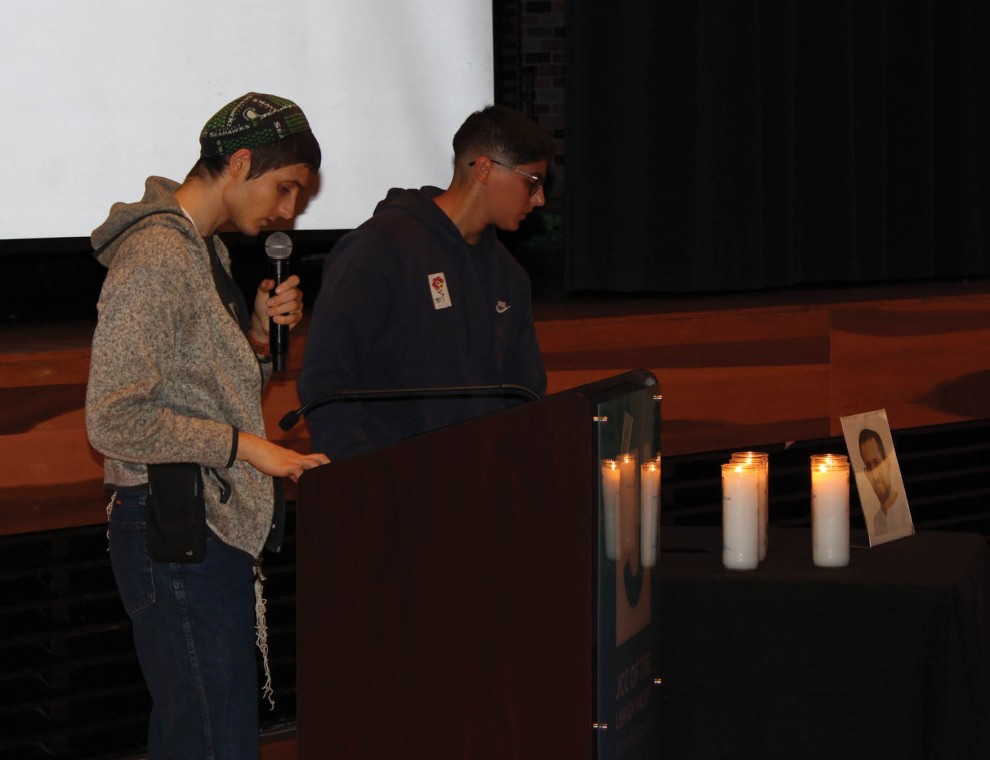
Each year on the anniversary of the 2023 Hamas attacks on Israel, the Jewish Federation of the Lehigh Valley organizes a commemoration to unite the community. This year, students from the Muhlenberg College Hillel participated in the ceremony front and center. A lot of them.
As the program of prayers, memories, songs, and candle lighting began, with contributions from students, rabbis, and other community members, one of the undergrads told the audience, “Tonight, as we remember those who were lost, we also pray for those who are suffering from the violence.” Another pointed up the vivid memories of the day: “Throughout Jewish communities around the world, many of us carry faces and stories with us that are deeply personal.”
One student shared the story of her Israeli uncle, who was called up with the Israeli Defense Forces reserve after the October 7 attacks. A 41-year-old tank crewman, he made the ultimate sacrifice after just weeks at the front, killed in battle on November 2. “He just did what he thought was right,” his niece said.
Next came the screening of the October 7 documentary “The Road between Us: The Ultimate Rescue.” The particularly powerful film follows one man, Noam Tibon of Tel Aviv, through the full day after the attacks began in the morning. The viewer quickly grows attached to him and his family and everyone connected with them.
The first scene is a short introduction to Nahal Oz, a kibbutz near the Gaza Strip. It’s a safe place, we’re told. A resident adds, “We never had a terrorist come into Nahal Oz.”
Then viewers are thrown headfirst into the frightening and heart-rending events of the day. Early in the morning, Noam’s son Amir, who lives in the kibbutz with his wife Miri and young daughters Galia and Carmel, contacts his dad about their situation. Amir has just told us on screen that “at 7:15, we hear it right outside our window (in their home’s safe room), and we hear people shouting in Arabic. At that point, we realized nobody was going to come (to help us), so I called my father.”
Noam had been a general in the Israel Defense Forces, retired after a lifetime of service. He was the person friends and family always thought of first in an emergency. “Whatever you needed,” his wife Gail says, “you call dad, of course. It’s a habit that the kids call him for 911.”
Noam thinks for a moment about what to do. “In a way I have to trust the IDF will do their job,” he says, “but something in my gut told me go, go, go.” He and Gail pack up their truck and leave Tel Aviv for the 60-mile ride. “I’m on a mission,” Noam says, “and I’m going to use all my experience to save my family.”
Sixty-mile drives don’t usually take 8.5 hours, but despite there being almost no vehicles on the road, military roadblocks, Hamas terrorists, and other situations requiring immediate attention slow the journey to a crawl. To name just two of the delays, there was passing the now-infamous Nova Music Festival and stopping to rescue two survivors, and then stumbling onto and joining a gunfight between terrorists and IDF soldiers, a successful gunfight.
By the time Noam reaches Nahal Oz, accompanied by a group of IDF soldiers he had unofficially recruited to his mission along the way, his son’s family has been locked in their safe room for over 10 hours. That whole time, terrorists roamed the streets as the family feared for their lives.
Noam leads the soldiers in clearing the kibbutz of terrorists, moving his small force forward methodically, step by step, as he’d done many times during his active IDF days. The routine carries on house to house. “You have to search everywhere, every corner,” Naom says. “When it’s clean, then we knock on the safe room.”
The group comes upon the Tibon house. They see clear signs of battle on the porch, but the house is closed up. “I saw that the door was locked,” Noam says, “and that gave me hope, because every house that we found where the door was locked, the people inside were alive.”
He and his crew get themselves inside and find the safe room. “Amir, it’s dad,” he calls. “Open the door.” His granddaughter Miri yells, “Grandpa is here!”
Noam enters the room. “I see my son,” he says. “He’s in his underwear. I hug him. I hug Miri. I give a kiss to Galia, a kiss to Carmel.” All are safe and well.
The Tibon house turns into a meeting place for neighbors as they’re rescued from their own homes. “Since our house was the sort of headquarters,” Miri says, “I tried to make sure that everyone was OK.”
By the time Noam and the soldiers had arrived, terrorists had killed more than a dozen residents of Nahal Oz. But now the kibbutz is clear and the survivors safe. “Everyone who I met,” says Noam, “we rescued their life. I didn’t leave anyone behind.”
Amir closes the film with an answer for skeptics and deniers of the depths of horror he and so many other Israelis lived through that day. “The story stands tall,” he tells the viewer. “And everyone who’s trying to deny it—I say, “This is my story.”