
By Carl Zebrowski
Editor
What subjects should be off limits for jokes? War? Terrorism? Inevitably you end up at: Can you make a Holocaust joke?
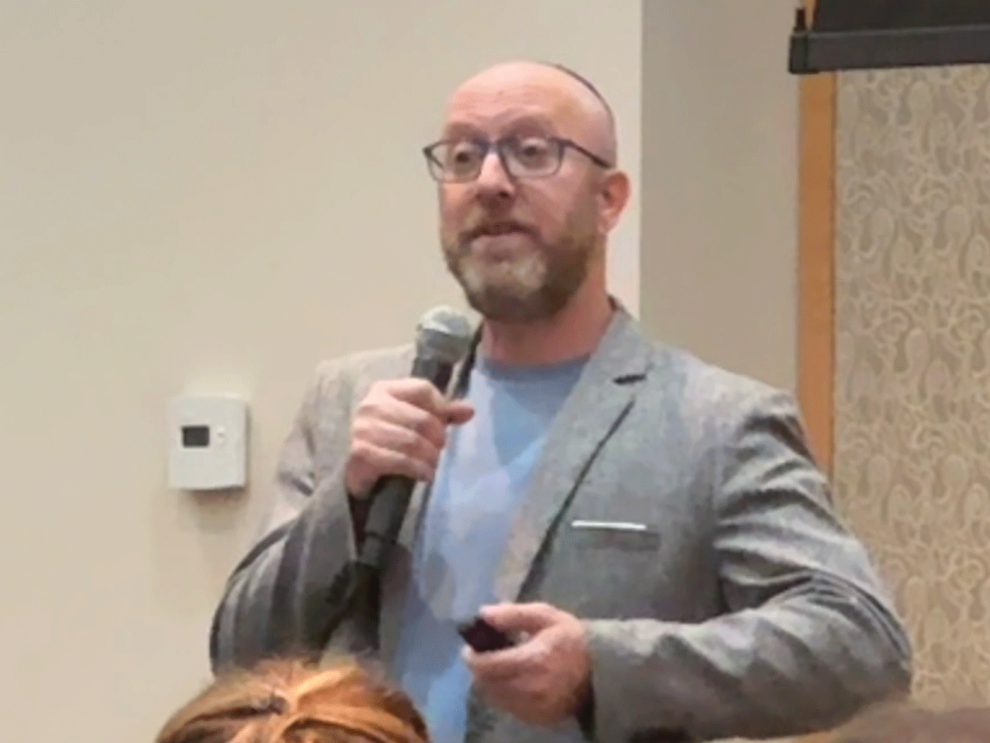
Speaking at Temple Beth El on November 5, Tel Aviv comedian and author Benji Lovitt replied yes. He told the large Jewish community audience gathered for his presentation “It’s Okay to Laugh” that, well, it really is OK to laugh—even when times have been tough like the last couple of years following the worst attack on Jews since the Holocaust, on October 7, 2023, with hostages taken and held in Gaza.
“We’re here to laugh tonight,” he said. “Jewish people know that we have to laugh to keep from crying.”
Lovitt was in town for this Jewish Federation of Lehigh Valley community-wide event that fits into his franchise combining comedy with capturing for people what makes Israel and Israelis unique. Born in California, he made aliyah 19 years ago and settled on this comedy-education niche a few years later.
He does standup routines that provide insight into the people of Israel, leads workshops giving glimpses of life there, and co-wrote the book “Israel 201: Your Next-Level Guide to the Magic, Mystery, and Chaos of Life in the Holy Land” with fellow comedian and educator Joel Chasnoff (who presented his standup routine to the Lehigh Valley last year).
After October 7, he focused his professional efforts on helping people cope with the tragedy of that day and the months since. “I created a new presentation on the power of dark humor,” he said.
In his exploration of topics many might consider off limits, he started with the big one: the Holocaust. He dug into the title number from “Springtime for Hitler,” the fictional musical in the Mel Brooks film “The Producers.”
“Springtime for Hitler and Germany,” the lyric goes. “Deutschland is happy and gay! We’re marching to a faster pace. Look out! Here comes the master race.”
The late Brooks, who served in the U.S. Army during World War II, had responded to criticism of his making jokes about that tragic subject matter with a matter-of-fact “I could either spend my whole life haunted or I could get revenge against the Nazis by making them look stupid.”
If you can push humor as far as the Holocaust, just what might it not be OK to approach. “There’s not a topic that someone can’t find some aspect of to laugh about,” Lovitt said.
EMTs and soldiers often share dark jokes, he said. They’re dealing with life and death all the time. There’s no avoiding that. “Bringing it down to earth with humor can make it less depressing,” he explained.
Israeli comedy is its own brand of Jewish humor. “It’s very different,” Lovitt said. “It reveals the scars of Israelis.”
There are a lot of scars living in a land of Holocaust survivors and their descendants, he said, and a land that’s always at war. Then came the Hamas attacks. “When something like October 7 happens, it rips the scars apart,” Lovitt said.
He mentioned soldiers earlier, and their dark humor. Well, Israel is a land of soldiers. “When everyone joins the army at 18,” Lovitt said, “it affects everyone.” They learn firsthand that danger can always be lurking right around the corner. Can people molded by such a reality really afford not to laugh? “There’s nothing we can’t laugh about,” he said.
Lovitt ended his presentation by putting a sentence related to the situation in Israel in large type up on the big screen behind him: “When are we ever going to be able to laugh again.” Meanwhile, he pointed out, sadness has little trouble forcing itself into expression. “We never question when we cry,” Lovitt said—the answer to when we can laugh again is now.
Jewish Federation President Bill Markson closed the program with a reminder that nights like this, filled with conversation and shared laughs, are essential. “Thank you all for coming tonight, because it’s all being together,” he said. “It all makes our life better.”
You can help the Jewish Federation present more nights like this, bringing the community together in unity and collectively working to make Jewish lives better locally (mostly), in Israel, and elsewhere in the world.