By Carl Zebrowski
Editor
A will isn’t only about what should happen with your money and possessions after you’re gone. It’s also about making sure you leave behind the legacy of your choosing rather than leaving a door open for a court to determine the distribution of your estate, possibly with unforeseen and unintended consequences. No will also means that charities you care about, including Jewish agencies, will likely be forgotten.
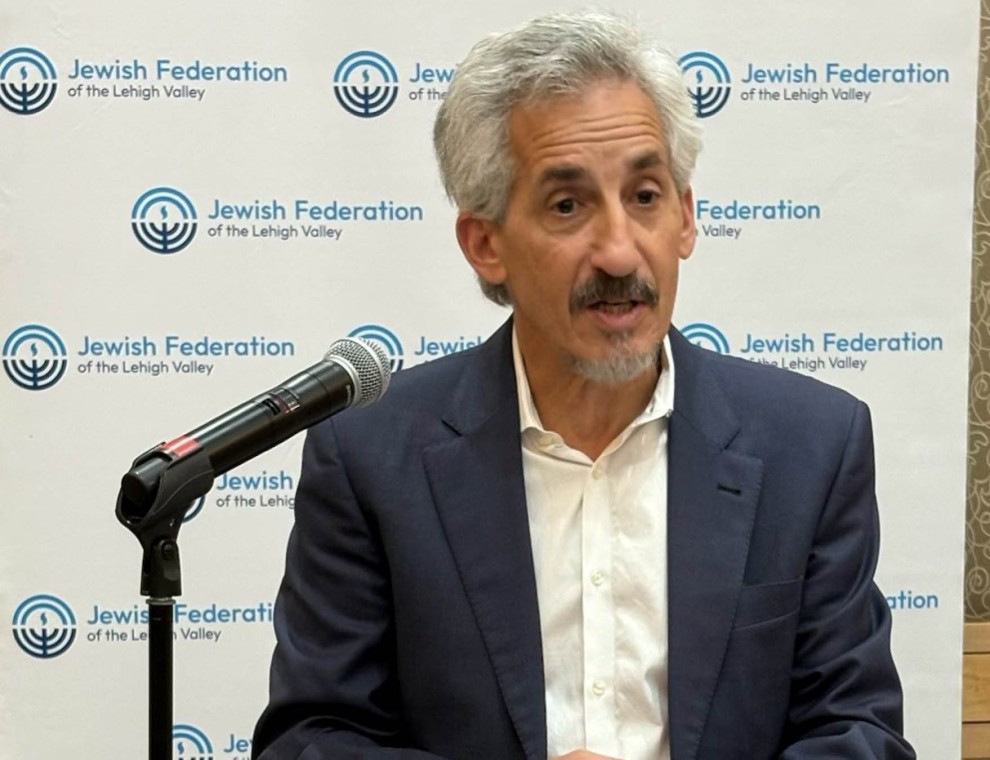
“Do I need a will?” was the introductory question Steve Weiner, an attorney of Stevens and Lee law offices, asked the audience for the May 8 program “Make a Will and Legacy” at Temple Beth El. Sponsored by the Jewish Federation of the Lehigh Valley, the night was part of the Harold Grinspoon Foundation Life and Legacy after-life giving program that the Federation administers locally.
“Look,” Weiner said, speaking as a hypothetical older adult, “I have adult children and they can have whatever there is.” While it’s generally true that an unmarried person’s assets go to their children in the absence of documents stating otherwise, the details aren’t always cut-and-dried. If there’s no will, for example, probate can kick in and require the court system to determine estate distributions.
“Even a simple will makes the process simpler,” Weiner continued. “Number one is write it down. A paper you wrote 30 years ago saying what to do takes precedence over what you said aloud to someone last week.”
Your will should explain how your assets should be distributed after you’re gone. “You write it for where you are today,” Weiner explained, and you base your determinations on your current situation and today’s laws, with one eye on the horizon. “It’s always something you can come back to in the future and change.”
The document may also name a guardian for minor children and maybe even for pets. While you’re doing the planning, you should also make an advance medical directive for yourself, as well as making a living will and designating a medical power of attorney. “If I can’t make medical decisions,” Weiner said, “who’s going to make those decisions, and what are those decisions going to be?”
Where do you start? With the very basics, Weiner said: “What do I own?” Maybe a house, an IRA, checking and brokerage accounts, vehicles. Next, he continued, it’s “what do you want to happen with your assets?”
It’s important to remember that certain assets will be dispatched prior to the will even coming into play. The balance in a joint checking account held by two people, for example, becomes the property of the survivor immediately upon the other’s death, regardless of whatever a will may state.
Then there are accounts like life insurance, which pay a designated beneficiary upon death. Those immediately go to the named beneficiary, even if a will may say otherwise. So make sure your beneficiaries listed on any account documents are up to date!
After you’ve taken care of your family, you should consider making donations. “One of the things of planning your estate is figuring out what you might give to Jewish agencies and charities,” Weiner said. That way you can continue to do your part to keep the Jewish community alive and thriving as well as make sure your own legacy in the community lives on.
What should you give to charity? “The IRA is always going to be the best,” Weiner continued. If you give the IRA to a person, that person must withdraw all the money from it before 10 years have passed. And—here’s the catch—that person has to pay both the Pennsylvania inheritance tax and the federal income tax on the amount withdrawn each year. If the IRA balance goes to a nonprofit instead, neither tax is taken out, so the organization ends up with 100% of the benefit.
Weiner pointed out that the Jewish Federation, which allots the funds it collects to the local Jewish community as well as for Jewish needs elsewhere around the world and for Israel. If you’d like to learn more about Life and Legacy and making sure your personal legacy of giving continues after you’re gone, contact Aaron Gorodzinsky, Jewish Federation director of development, at [email protected] or 610-821-5500.